

Zone 2 training has become one of the most talked-about approaches among runners, cyclists, and people looking to improve their aerobic fitness. The idea sounds simple: exercise at a relatively comfortable intensity that you can sustain for a long time without turning every workout into a race against the clock.
But there is one important detail: Zone 2 does not have one universally accepted definition.
In a 2025 expert consensus on Zone 2 training, specialists in exercise physiology and endurance training recommended that what is commonly called Zone 2 should preferably be performed at an intensity just below the first lactate threshold or first ventilatory threshold. At the same time, different watches, apps, and training systems may use different numbers and terminology.
That is why relying on a single number on your watch may not be enough. Heart rate, perceived effort, breathing, and, when available, physiological testing should be considered together.
In this guide, you will learn what Zone 2 is, how to estimate your intensity in practice, which benefits are actually supported by evidence, and why this type of training should not be treated as a magic formula.
Zone 2 training at a glance
- Zone 2 is a relatively comfortable and sustainable aerobic intensity.
- From a physiological perspective, it is commonly positioned just below the first lactate or ventilatory threshold.
- In many commercial five-zone systems, Zone 2 is roughly 60% to 70% of maximum heart rate, but this is only an estimate.
- The “talk test” is a practical tool: during moderate-intensity exercise, you can usually talk, but singing becomes difficult.
- Zone 2 training can be part of an effective aerobic routine, but there is no evidence that it is the single ideal intensity for every goal.
- Running, brisk walking, cycling, rowing, and other aerobic activities can all work as long as you reach the appropriate intensity.
What is Zone 2 training?
Zone 2 is an intensity range used to organize aerobic exercise.
In practical terms, it represents an effort where you are clearly exercising but do not feel like you are pushing hard. Your breathing increases but remains controlled. You can usually maintain the pace for a long time, and recovery tends to be easier than after a high-intensity session.
The confusion begins when different systems use the same name for different intensity ranges.
In scientific three-zone models, for example, the numbering may describe different physiological ranges than those displayed by a consumer sports watch. Many wearable devices instead use five heart-rate zones and classify Zone 2 as approximately 60% to 70% of maximum heart rate.
Before comparing your numbers with someone else’s, find out which method your watch or app uses to define its training zones.
Why has Zone 2 training become so popular?
One reason is that it allows people to accumulate aerobic training without performing at a high intensity every day.
For runners and cyclists, that can be especially useful. Easier sessions can help build training volume while harder workouts are scheduled on other days.
A systematic review of middle- and long-distance runners found that endurance athletes often perform a large share of their training at lower intensities while reserving a smaller portion for threshold and high-intensity work.
That does not mean everyone needs to copy the training distribution of an elite athlete.
A 2025 review focused specifically on the growing popularity of Zone 2 concluded that current evidence does not support the idea that Zone 2 is universally the best intensity for maximizing mitochondrial capacity, fat oxidation, or cardiometabolic health in the general population. Higher-intensity exercise also plays an important role, particularly when overall training volume is lower.
The practical takeaway is more useful than the promise of a “perfect zone”: Zone 2 is a training tool, not your entire training program.
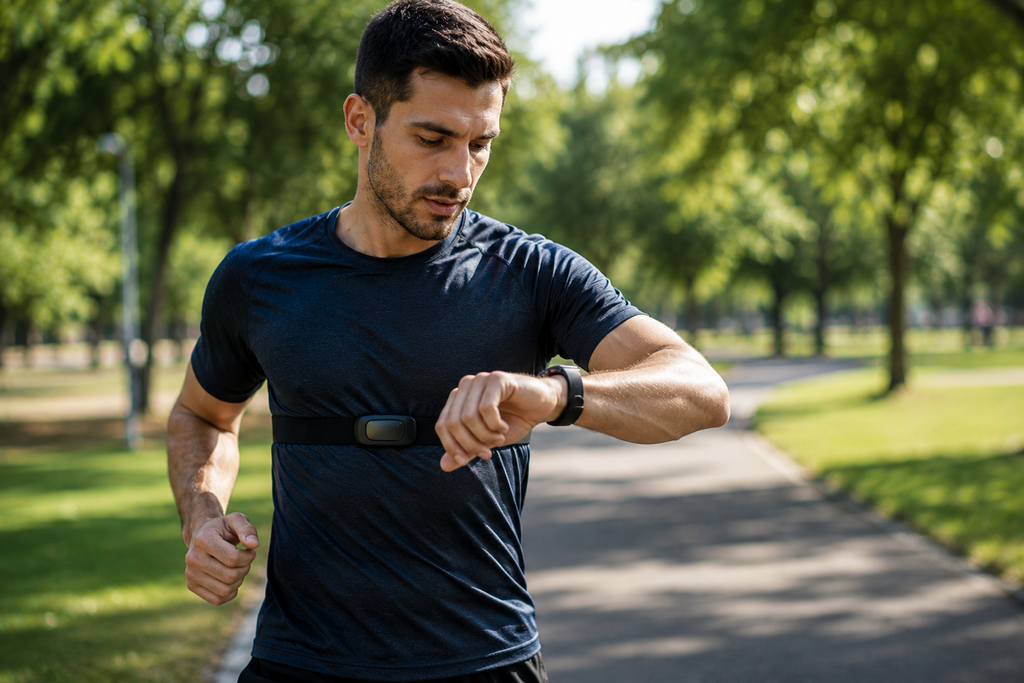
How do you calculate your Zone 2 heart rate?
The simplest method starts by estimating your maximum heart rate.
One well-known equation in the scientific literature is:
Estimated max heart rate = 208 − (0.7 × age)
The formula was proposed from a meta-analysis and later validated in laboratory settings, but it is still a population-level estimate. Two people of the same age can have different maximum heart rates.
For example, consider a 40-year-old:
208 − (0.7 × 40) = approximately 180 bpm
If that person uses a conventional five-zone system where Zone 2 corresponds to approximately 60% to 70% of maximum heart rate, the estimated range would be:
60% of 180 = 108 bpm
70% of 180 = 126 bpm
In this example, the watch might show approximately 108 to 126 beats per minute as Zone 2.
However, this calculation should not be interpreted as an exact physiological boundary.
Estimated maximum heart rate has a margin of error, training-zone systems vary, and the first physiological threshold does not occur at exactly the same percentage for everyone.
Use the calculation as a starting point, not an absolute rule.
Is there a better way to find your Zone 2?
Yes.
In a sports-performance or laboratory setting, lactate testing or cardiopulmonary exercise testing can identify individual thresholds much more precisely.
The 2025 expert consensus places Zone 2 training immediately below the first lactate or ventilatory threshold as the preferred physiological reference.
For people without access to laboratory testing, there is a much simpler option.
Use the talk test
The talk test estimates exercise intensity based on your ability to speak while exercising.
According to the CDC, during moderate-intensity aerobic activity you can usually talk, but you would have difficulty singing. During vigorous activity, saying more than a few words without pausing for a breath becomes difficult.
For an easy endurance workout, aim for an effort where you can speak in complete sentences without becoming noticeably out of breath.
The talk test does not replace physiological testing and cannot define Zone 2 perfectly, but it is a useful real-world check that can help prevent an easy workout from gradually becoming too hard.

How do you do a Zone 2 workout?
A Zone 2 workout does not need to be complicated.
Beginners can choose brisk walking, easy running, a stationary bike, outdoor cycling, an elliptical, or another aerobic activity that makes it easy to control intensity.
A simple session could look like this:
Warm-up: 5 to 10 minutes at a very comfortable effort.
Main set: about 25 to 40 minutes at a steady, conversational effort.
Cool-down: another 5 to 10 minutes while gradually reducing your effort.
These times are not a universal prescription. A beginner may need a shorter session, while a well-trained athlete may comfortably sustain this type of effort for much longer.
The main goal is to avoid turning the workout into a constant pursuit of speed.
On an uphill section, for example, you may need to slow down. On a hot day, your heart rate may also rise even if your pace stays the same.
It is the internal intensity of the exercise, not the desire to hold a certain pace, that should guide this type of session.
Do you have to run to train in Zone 2?
No.
For some people, especially beginners, running can already push heart rate above the desired range. In that case, brisk walking or alternating between walking and running may be a better option.
Cycling also works well because resistance can be adjusted gradually.
The activity itself is secondary. What defines the workout is the intensity.
Does Zone 2 training help with weight loss?
It can be part of a routine that increases energy expenditure and improves fitness, but the phrase “fat-burning zone” often creates confusion.
At lower exercise intensities, the body may use a greater proportion of fat as fuel. That does not mean staying in that range is automatically the best strategy for losing body fat.
The 2025 review that specifically examined the popularity of Zone 2 warned that there is not enough evidence to treat it as superior to every other intensity for maximizing fat oxidation, mitochondrial capacity, or cardiometabolic health.
For body composition, total activity level, nutrition, resistance training, exercise intensity, recovery, and consistency all matter.
Zone 2 is one useful tool within that bigger picture.
Do you need a watch or heart rate monitor?
No.
You can perform a comfortable aerobic workout using perceived effort and the talk test.
However, people who want to track heart rate more consistently may benefit from using a heart rate monitor.
That can be especially useful when comparing workouts, noticing changes in intensity, or preventing an easy run from gradually becoming harder than planned.
Optical wrist sensors in sports watches have improved considerably, but accuracy varies depending on the device and activity. In a validation study during aerobic exercise, a chest strap showed the highest agreement with electrocardiography among the devices evaluated.
A chest strap can make heart-rate tracking easier
Affiliate disclosure: This content contains affiliate links. We may earn a commission from qualifying purchases at no additional cost to you. As an Amazon Associate I earn from qualifying purchases.
If you want to monitor heart rate while running, cycling, or doing other aerobic workouts, a chest strap heart rate monitor with Bluetooth and ANT+ can make it easier to track intensity consistently during training.
View a Bluetooth and ANT+ chest strap heart rate monitor on Amazon
Common Zone 2 training mistakes
The first mistake is assuming the zone shown on your watch is perfectly accurate. Formulas and devices rely on estimates unless your zones have been individually tested and configured.
Another common mistake is going too fast. You start at an easy effort, look at your pace, and decide to speed up because the workout feels “too easy.” A few minutes later, what was supposed to be a low-intensity aerobic session has turned into a moderate workout.
It also does not make sense to turn Zone 2 into a religion.
A complete training routine can include resistance training, higher-intensity sessions, skill work, and other types of exercise depending on your goals.
World Health Organization recommendations for adults include 150 to 300 minutes of moderate-intensity aerobic activity per week, or 75 to 150 minutes of vigorous-intensity activity, along with muscle-strengthening activities on two or more days per week. These recommendations are not a specific Zone 2 prescription, but they illustrate why different types of training can coexist.
How often should you do Zone 2 training?
There is no universal number.
How often you train in Zone 2 depends on your current fitness level, sport, weekly training volume, higher-intensity workouts, and ability to recover.
For beginners, the priority should be increasing training load gradually rather than immediately copying the routine of an advanced runner or cyclist.
If you have a known cardiovascular or respiratory condition, experience chest pain, fainting, unusual shortness of breath, or take medications that significantly affect heart-rate response to exercise, training intensity should be individualized with guidance from a qualified healthcare professional.
Is Zone 2 training worth it?
Yes — as long as you understand what it actually is.
Zone 2 training is an effective way to include sustainable aerobic exercise in your routine, manage intensity, and accumulate training volume without turning every workout into an all-out effort.
The mistake is treating a percentage on your watch as a perfect physiological boundary or assuming Zone 2 should replace every other type of training.
Use heart rate as a reference, pay attention to perceived effort, try the talk test, and observe how your body responds over time.
The best workout is not the one where your watch displays the prettiest zone. It is the one that delivers the intended training stimulus and can be repeated consistently.