
One ball, two goals, and one fundamental rule: put the ball in the opponent’s net.
Football is the most popular sport in the world, a passion that crosses countries, cultures, languages, and generations. But what explains the scale of this phenomenon?
It may seem too simple to explain a worldwide phenomenon. But perhaps that is precisely where part of the secret lies.
From Europe’s great arenas to the dirt pitches of Latin America. From African schools to Asian streets. From Brazilian beaches to stadiums that welcome tens of thousands of people, football has developed an ability that few cultural phenomena have ever achieved: it can be understood and played almost anywhere on the planet.
But size alone does not explain everything.
Why has football, in particular, managed to reach so far?

There are at least seven reasons.
1. To start playing, you practically only need a ball
This may be the greatest competitive advantage football has ever had.
Basketball needs a hoop. Tennis requires a racket, a ball, and at least a suitable court. Motorsport demands enormous financial resources. Golf needs a course and specific equipment.
Football can survive with much less.
Two stones can become goalposts. A wall can become a goal. A street can become a pitch.
And when an official ball is unavailable, entire generations have learned to play with improvised objects.
This dramatically lowers the barrier to entry.
Before someone becomes a fan, that person can simply start playing.

2. The basic rules are relatively easy to understand
There are offsides, fouls, cards, free kicks, penalties, and countless interpretations that make football complex at the highest level.
But understanding the objective of the game is extremely simple:
two teams try to put the ball into the opposing team’s goal.
This is incredibly powerful when attracting new audiences.
Someone can watch a match for the first time without knowing every detail and still quickly understand who is attacking, who is defending, and what a goal means.
3. The same game belongs in the Maracana and on the neighborhood pitch
There is something fascinating about football’s structure.
The fundamental rules used in the world’s greatest competitions essentially belong to the same system of rules used in much smaller matches.
The IFAB emphasizes this universality: the Laws of the Game are designed to apply globally, from major international competitions to matches played by children, subject to adaptations permitted by the rules themselves.
This creates a powerful connection.
A child taking a free kick on a local pitch can imagine scoring the decisive goal in a World Cup.
A youngster who improvises two goalposts can imagine that patch of ground is one of the greatest stadiums on the planet.
Professional football may look enormous, but the game remains recognizable to anyone who plays it in the street.
4. Goals are rare—and that is exactly why they matter so much
Compare football with other sports.
A basketball game can produce hundreds of points between the two teams.
In football, a match can end:
1-0.
At first glance, that might seem like a disadvantage.
In practice, it turns every goal into an event.
A single play can decide a final. One mistake can change a championship. One save can turn a goalkeeper into a hero. A shot in the 90th minute can become part of a club’s history.
Scarcity creates tension.
And tension creates emotion.
That is why millions of people can remain focused on a match for almost two hours, knowing that a single second can change everything.
5. Football turns players into characters
Pele.
Maradona.
Marta.
Messi.
Cristiano Ronaldo.
Ronaldo.
Zidane.
Ronaldinho.
The list could continue for pages.
Football does not sell only matches. It creates characters, rivalries, downfalls, redemptions, and stories.
There is another fundamental element: players can have completely different characteristics.
There is room for speed, strength, tactical intelligence, technique, creativity, leadership, explosiveness, and improvisation.
That is why different generations find their own heroes.
And the debate never ends:
Who was the greatest?
Perhaps that question will never have a definitive answer—and that is exactly why it keeps generating conversation.
6. Clubs and national teams turned football into identity
For millions of fans, football is not simply entertainment.
It is belonging.
A shirt can represent a city, a family, a neighborhood, or even a tradition passed from parent to child.
With national teams, that feeling takes on another dimension.
People who support rival clubs for years suddenly rally behind the same colors.
This is one reason major international competitions reach beyond regular football fans and attract people who barely follow the sport during the rest of the year.
Football can turn a match into an expression of collective identity.
7. Because football learned to belong to everyone
Perhaps this is the reason that connects all the others.
Football crossed borders.
FIFA currently has 211 member associations across six continents, demonstrating the scale of the global infrastructure built around the sport.
But its presence does not depend only on major institutions.
Football exists simultaneously as:
a professional sport, a game, physical activity, a career, a spectacle, a business, and a cultural expression.
It can be played in major sports centers or improvised in small spaces.
And that made something extraordinary possible:
every country incorporated football into its own culture.
Brazil developed its own relationship with the game.
Argentina developed another.
England developed another.
Countries across Africa, Asia, Europe, and Latin America created their own schools, rivalries, heroes, and ways of supporting the game.
Football became global without necessarily becoming the same everywhere.
Why is football the most popular sport in the world?
There is probably no single reason.
Football conquered the world because it combines qualities that are difficult to find simultaneously in another sport:
it is simple to start, inexpensive to play, easy to understand, difficult to master, and exciting to watch.
You can learn its basic rules in just a few minutes.
But you can spend a lifetime trying to understand it completely.
Perhaps that contradiction is what makes the game so fascinating.
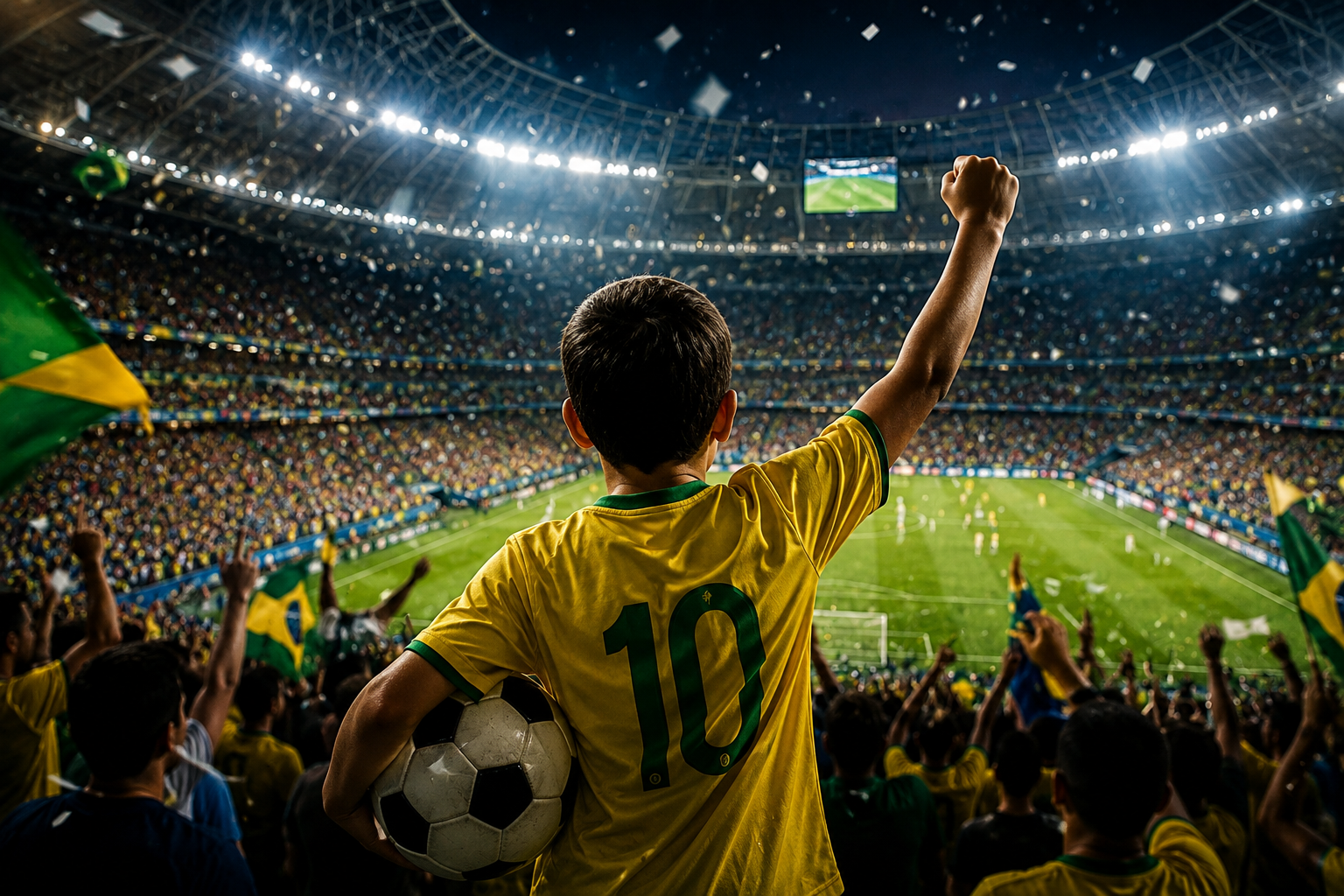
A child needs only a ball to begin.
And with it, that child can imagine an entire stadium.
That is how a relatively simple game managed to cross generations, languages, and borders.
And turned a ball into one of the greatest sporting passions on the planet.